|
|
Diagnosis of ENT (ENT
Unit,ENT Exam Unit, ENT Treatment Unit)
Disorders |
Ear, Nose and Throat (ENT)
Surgery |
|
Pediatric ENT Treatment
for Children |
Ear, nose, and throat
health and treatment for children |
|
Neuromonics Tinnitus
Treatment Study Published in ENT Journal |
|
| |
|
Diagnosis of ENT
Disorders |
Many tests are used to diagnose ENT disorders.
Regardless of your particular ailment, there is
specific information you should always have ready
for your physician to help him diagnose your
problem. Here are some of the questions your doctor
may ask:
■What
are your symptoms and when did they start?
■Have
you been taking any medications (over the counter,
including vitamin and herbal supplements or
prescription)? If so, your doctor will want to know
the dosage.
■Are
you allergic to any medications? If so, what are
they and what kind of reaction did you have?
■Do
you have a previous history of ENT disorders?
■Do
you have a family history of ENT disorders?
■Do
you have any other medical conditions?
■Have
you been running a fever?
Here are additional questions if the patient is a
small child:
■Has
the child had nausea and vomiting? If so, has the
child continued to have wet diapers?
■Has
the child been abnormally fussy or lethargic?
■Has
the child had balance problems?
■Has
the child's eating and drinking habits changed?
■Has
the child shown signs of decreased hearing, such as
not responding to their name immediately or not
startling at loud noises?
Diagnosis of Ear Infections
If you have signs and symptoms of an ear infection,
your doctor will use an otoscope to visualize the
outer ear and eardrum. If an infection is present,
the ear may appear red and swollen. There may also
be a fluid discharge. Unlike other infections, the
exact bacteria that is responsible cannot always be
determined. As such, doctors choose antibiotics that
will cover the most likely organisms when they
suspect a bacterial source. This is because it can
be difficult to obtain a sample from the ear for a
culture. Antibiotics will not cure a viral
infection, and it can take as long as three weeks
for your body to fight off the virus.
Diagnosis of Swimmer's Ear
With swimmer's ear, the outer ear and ear canal may
be red. Upon examination, the doctor may notice pus
in the ear canal, and the skin may be scaly or
shedding. The doctor may be able to obtain a fluid
sample for culture.
Diagnosis of Sinus Infections
If a sinus infection is suspected, an endoscope may
be used to go up the nose and visualize the opening
in to the sinus cavity and take a direct sinus
culture. Nasal swabs are not useful due to false
positive results that do not reflect the sinus
pathogen. By endoscope, the doctor will be looking
for inflammation and/or discharge. Four view x-rays
or a CT scan may be indicated if other tests are
inconclusive.
Diagnosis of Strep Throat
Strep throat causes enlarged reddened tonsils that
sometimes have white patches on them; however, many
viral infections can cause this as well. If strep
throat is suspected, a throat culture will be taken
and sent to the lab. This test is quick and easy to
perform with only mild discomfort as it may cause a
gagging sensation. A cotton swab is brushed against
the back of the throat then sent to the lab to test
for streptococcal bacteria, the cause of strep
throat. The standard test can take 1 to 2 days;
however, a rapid strep test can also be performed,
which only takes a few minutes. If the rapid strep
test is positive, antibiotics will be started. If
the rapid strep test is negative, you will be sent
home and the standard culture will still be
performed. About 20% of negative rapid strep tests
will become positive after a day or two in the
laboratory. Sometimes your doctor may make the
diagnosis based on classic symptoms and signs to
treat you presumptively even without a swab.
Diagnosis of Sleep Apnea
Sleep apnea is a disorder causing one to stop
breathing for brief periods of time while sleeping.
In your first visit, the doctor will begin by
obtaining a comprehensive medical history. Before
ordering a sleep study, he or she will likely ask
some of these questions:
■Have
you ever been told that you snore?
■Have
you ever been told that you have stopped breathing
while asleep?
■Do
you awake refreshed in the morning or do you suffer
from daytime drowsiness?
■Do
you suffer from mood swings or depression?
■Do
you wake up frequently in the middle of the night?
The doctor will look inside your mouth for evidence
of enlarged tonsils, uvula(a bell-like piece of
tissue that hangs down from the roof of the mouth
toward the back of the throat) or other structures
that may be blocking the airway. The uvula contains
some glands and affects vocal resonance. If the
doctor suspects sleep apnea, they may order a sleep
study. Sleep studies are usually conducted at a
sleep center. After you fall asleep, a monitor,
which measures the oxygen concentration in your
blood, will be placed on your finger. Normal oxygen
saturation during sleep in otherwise healthy men and
women is 95% to 100%. If you stop breathing while
asleep, this number will drop. Another sleep study
used to diagnose sleep apnea is called a "polysomnogram."
It measures not only the amount of oxygen in your
blood, but brain activity, eye movement and muscle
activity, as well as your breathing and heart rate.
Based on your present symptoms, your doctor may
choose to use a combination of these tests to
diagnose your specific disorder. He will then use
this information to create an effective treatment
plan. |
| Article Source: |
| http://ent.about.com/od/diagnosingentdisorders/a/basicdiagnosis.htm |
|
Back To Top |
| |
|
Ear, nose, and throat
health and treatment for children |
by Dr. Nina Shapiro of UCLA
Ear Infections
Why does my child get ear infections? Ear
infections, or otitis media, are very common in
children as well as infants. Otitis media is an
infection of the middle ear, behind the eardrum.
Fluid may accumulate in the middle ear, and become
infected from bacteria or viruses which reside in
the back of the nose or the throat. The middle ear
is connected to the nose and throat by the
eustachian tube, one on each side. This muscular
tube is immature in both its size and orientation in
young children. As they grow, the tube changes
direction from a horizontal angle to more of an
acute angle, allowing for better drainage and
pressure equalization in the middle ear. Children
may also have enlarged adenoids contributing to
recurrent ear infections. Adenoids are a mass of
lymphoid tissue that sit behind the nose. If they
are enlarged, they may block the ability of the
eustachian tube, which extends from the middle ear
to the adenoid region, to allow fluid drainage from
the middle ear. Bacteria may also remain in the
adenoid region, and may further lead to risk of
recurrent ear infections.
There are certain 'risk factors' which have been
shown to put a child at increased likelihood of
having recurrent ear infections. For infants, taking
the bottle to bed at night may result in bottle
feeding 'refluxing' into the back of the nose, and
even eustachian tubes. This may cause swelling; or
even fluid accumulation, in the middle ear. Breast
feeding is associated with a lower incidence of
recurrent ear infections in infants. The combination
of feeding in an upright position and exposure to
protective maternal antibodies contribute to this.
Tobacco exposure is known to increase the incidence
of otitis media in infants and young children. You
should not smoke. It is bad for you and for those
around you. That goes without saying, but still
needs to be said. Higher incidence of recurrent ear
infections in children of smokers is yet another
reason to stop.
Daycare is a catch 22. It is an integral important
part of society in families with two working
parents. However, there has been an increased
overall incidence of recurrent otitis media in
children in daycare. Exposure to many children with
a multitude of infections has been associated with
higher incidence of recurrent ear, nose, and throat
infections in young children.
Antibiotics yet another catch 22. Many ear
infections are treated with antibiotics. This is the
standard treatment. However, the more antibiotics
that are used, the more likelihood that 'resistant'
bacteria can grow. These 'resistant' bacteria are
organisms that have 'seen' certain antibiotics
before, and select out 'stronger' strains that can
survive despite antibiotics.
What are ear tubes? Ear tubes are small plastic or
metal tubes that are inserted in the eardrum. A tiny
opening, the size of a dash on this page, is made in
the eardrum to drain the fluid. The tube, which
looks like a tiny spool, is placed in the eardrum
opening and rests in the eardrum by itself. The
central opening of the tube is approximately one
millimeter. The tube will in most cases fall out on
its own within 8 24 months. (average of one year).
Tubes act as 'mature' eustachian tubes that allow
fluid drainage from the middle ear to the outside in
the event of ear infections. They do not prevent ear
infections, but allow drainage when infections
occur. They may also significantly improve hearing.
Complications of otitis media: Like any
illness, there are 'major' and 'minor' complications
from ear infections.
Hearing loss: Recurrent ear infections, either from
persistent fluid in the ear, or from recurrent acute
infections, may cause hearing loss. An infant under
12 months who does not seem to respond to sound may
have hearing loss. An infant at 18 24 months who
does not speak single words yet may have hearing
loss. Toddlers and young children who seem to
'ignore' you may have hearing loss. This may be hard
to evaluate, as a certain degree of 'selective'
hearing may be normal in this age group. If the
television or radio is at rock concert levels in
order for your child to hear it comfortably, he or
she may have hearing loss. If there is an attention
problem at school, your child may have hearing loss.
Major complications: High fever, stiff neck,
swelling behind the ear, foul drainage from the ear,
or weakness of the muscles of the face are some of
the major complications from Otis media that should
be attended to on an emergency basis.
Nosebleeds
Most nosebleeds in children originate from the front
part of the nose. The nasal cavity is divided into
right and left sides by the nasal septum. This
structure has many small arteries and veins that can
bleed from minimal trauma. In children, trauma may
be 'digital' (nose picking), from dry air, or
frequent nose blowing. Nosebleeds may take place
while your child is asleep, or spontaneously during
the day.
Basic measures to try to control nosebleeds are
first to see if your child is picking his or her
nose. Check their fingernails! If the air is dry
where you live, a humidifier may help. Over the
counter sprays that have saline (saltwater) only are
potentially beneficial and safest for children.
Nasal decongestant sprays, especially for more than
a day or two, can be drying and make bleeding more
problematic.
For acute nosebleeds, gently but firmly pinching the
nostrils together may control bleeding. Ice wrapped
in a washcloth placed over the bridge of the nose
may also help.
For the most part, nosebleeds may simply be an
annoyance. HOWEVER, recurrent severe nosebleeds
(those that don't stop on their own or with gentle
pressure) need to be evaluated. There are several
rare, although not unheard of, nasal growths that
can present themselves as nosebleeds in children.
There are also some rare, although not unheard of,
bleeding disorders that may first present as
nosebleeds.
Snoring
Snoring in children can be mild, with some
occasional noisy breathing during sleep, to severe,
whereby loud snoring is intermixed with actual
difficulty breathing. The most common cause of
snoring in children is enlarged adenoids and/or
tonsils. The adenoids are lymphoid tissue that sits
directly behind the nose, above the roof of the
mouth. Enlargement may cause your child to be a
'mouth breather' while awake as well as while
asleep. During sleep, the combination of lying flat
and the relaxation of the tissues in the back of the
throat result in the noise of snoring as the soft
palate vibrates against the back of the mouth. The
tonsils are lymphoid tissue that sit in the back of
the mouth. If they are enlarged as well, the snoring
may be more significant.
'Sleep apnea' is a more severe form of snoring
whereby loud snoring may be mixed with gasping,
grunting, or actual pauses in breathing during
sleep. You may hear your child snoring, struggling
for air, followed by periods of silence and then
even choke to resume breathing. Children with
various degrees of sleep apnea may have restless
sleep patterns, frequent wakening at night, or
bedwetting. They may be lethargic during the day,
fall asleep during daytime activities, and have an
overall lower energy level than you would expect in
young otherwise healthy children.
Mild snoring is common and not necessarily a
significant concern. Loud snoring or any signs of
breathing difficulty while awake or asleep needs to
be evaluated
Sinusitis
There are four sets of sinuses that develop around
the nose (paranasal sinuses). They are fully
developed by early teenage years. At birth, the
maxillary sinuses (cheek area) are small but
present, and the ethmoid sinuses (behind the nose,
between the eyes) are present as well. In later
childhood, the frontal (forehead) and sphenoid (most
posterior, behind the ethmoids) sinuses develop.
Sinus problems in children most often involve the
maxillary and ethmoid sinuses.
It is often difficult to diagnose sinusitis in
children. When is it a cold, cough, flu, or
bronchitis, and when is it a sinus infection? During
the first week of a respiratory tract illness, it is
nearly impossible to distinguish a 'cold' from
sinusitis. Certain signs may be more indicative of
acute sinusitis, such as foul yellow or green
drainage from the nose, high fevers, headache or
facial pain, swelling around the eyes, or persistent
cough. Actual sinusitis, beyond a cold or flu,
usually needs to be treated with antibiotics.
If your child seems to have recurrent problems with
nasal congestion, nasal drainage, headaches,
persistent cough, or fevers, he or she may have
chronic sinusitis. There are many possible causes of
this. Children's sinuses tend to be very small in
relation to their face, and the slightest
inflammation preventing their drainage may result in
chronic or recurrent sinus infections. Environmental
allergies, such as those to dust, mites, or pollen,
may trigger inflammation in the nose and sinuses and
lead to chronic sinus infections. Children with
medical problems such as asthma, cystic fibrosis, or
immune deficiencies have a higher likelihood of
suffering from recurrent sinus infections. Enlarged
adenoids may contribute to sinus problems,
especially in young children.
Hoarseness
Why is my child hoarse? A hoarse or rough voice can
be very common in children. It may be a self limited
voice change due to a cold or cough resulting in
laryngitis. A hoarse voice in a child, or a weak or
rough cry in an infant may be caused by other
factors.
Children with other young siblings, or those who
spend a lot of time with other children may develop
a hoarse voice from voice 'overuse' or voice
'abuse'. This may put strain on the vocal cords,
which are the muscles of the voice box responsible
for creating the sound of voice. Just like other
muscles in the body, the strain of misuse may result
in swelling or inappropriate use of other muscles.
Prolonged misuse may result in vocal nodules, or
'screamer's nodules'. These are the vocal cord
equivalents of blisters or calluses that may form on
one's feet by wearing poorly fitting shoes.
Another possible cause of hoarse voice in children
is gastroesophageal reflux. This consists of tiny
amounts of regurgitated food or liquid from the
stomach that may irritate the voice box. The opening
to the esophagus ("food pipe") is just behind the
opening to the voice box. Given that these openings
are so close, it is not uncommon that acid or food
particles from the stomach or esophagus may enter
the voice box, causing chronic irritation to the
vocal cords. This may even result in chronic cough
or breathing problems. This entity tends to be more
common in younger children and infants, although it
can certainly be seen in older children as well as
adults.
There are growths that may develop on the vocal
cords of children, most of which are uncommon, but
are seen occasionally by ear, nose and throat
physicians.
Any child or baby that is hoarse, or has a change in
their voice for a prolonged period of time, merits
an evaluation by an ear, nose and throat physician
before therapy should be recommended. |
| Article Source: |
| http://www.ent-consult.com/shapiro.html |
|
Back To Top |
| |
|
Pediatric ENT Treatment
for Children |
Kids are physiologically different than adults.
Most of our physicians at ENT and Allergy Associates
treat the spectrum of common pediatric ENT problems,
including Tonsillitis and Adenoiditis, Chronic Ear
Problems, Congenital Abnormalities of the Ear,
Hearing Loss, Hoarseness and Hypernasal Speech,
Otitis Media and Otitis Externa (Swimmer’s Ear) as
well as other disorders such as neck lumps and
masses, nasal deformities and obstruction.
Tonsils and Tonsillitis
The tonsils are located in the back of the throat.
Although the tonsils have a role in helping treat
infection, the tonsils can become part of the
infection as well. When this happens, removal of the
tonsils will improve your child's health. Removal of
the tonsils has not led to an increase in infections
or a loss of immune (disease fighting) function.
This is because there are hundreds of other lymph
nodes in the head and neck that perform the same
function.
Tonsillitis is an infection of the tonsils. This
infection usually involves the back of the throat as
well (pharyngitis). This infection is uncommon in
children less than one year old. It is seen most
frequently in children four to seven years of age,
and continues less frequently throughout late
childhood and adult life.
In most cases, viruses are the most common cause of
tonsillitis. The second most common cause is a
bacteria known as Streptococcus, otherwise known as
"strep throat". Other bacteria can cause
tonsillitis, but much less frequently.
Tonsillitis usually results in a sore throat and
difficulty swallowing. The throat visibly looks
inflamed (red). In younger children, refusal to eat
may be noted. Fever, headache, earache, and enlarged
and tender glands in the neck may also be
experienced. Tonsillitis can br viral or bacterial.
Viral tonsillitis is primarily treated with bed
rest, Tylenol for fever and pain relief, and lots of
fluids. Antibiotics do not help treat this type of
infection. Streptococcal tonsillitis does require
the use of antibiotics, primarily to help get rid of
the infection quickly and prevent complications.
Complications can include an infection in the
bloodstream, heart problems, rash, and others.
Tonsillitis can become difficult to treat (chronic
tonsillitis) or infections may recur frequently.
This can result in fatigue, poor weight gain, poor
school attendance among other things. Occasionally
an abscess or collection of pus may develop around
the tonsils and needs to be drained.
The tonsils can become so enlarged (tonsillar
hypertrophy) that your child may have difficulty
breathing (especially at night) or difficulty
swallowing. You should call your physician if your
child is experiencing any of these symptoms.
Actually, there several of tonsil tissue located in
the back of the throat The tissue referred to as the
"tonsils" is located on either side of the back of
the mouth. The second area of tonsil tissue is
located behind the nose, and is called the adenoid.
Adenoids and Adenoiditis
The adenoid is a lump of tissue at the back of the
nose above the tonsils. In order to see them, your
physician can look through your mouth and view the
back of your nose using a mirror, may choose to look
with a flexible camera in the nose.
The adenoid is basically a lymph node. A lymph node
contains lymphocytes, which are cells that help to
fight infection. The adenoid is a part of a group of
lymph nodes that include the tonsils, found around
the back of the throat. Together, they act to help
process infections in the nose and throat.
Unfortunately, sometimes the adenoid tissue gets
infected and the infection can last for weeks or
months. This is called adenoiditis. If you have
adenoiditis, you may have a runny or stuffy nose,
post-nasal drip, headache or cough.
Usually adenoiditis is treated with antibiotics
taken by mouth. If antibiotics fail to get rid of
the infection, the adenoid tissue may have to be
removed.
In most children, the adenoid enlarges normally
during early childhood, when infections of the nose
and throat are most common. They usually shrink as
the child gets older and disappear by puberty.
However, in some children, the adenoid continues to
become larger and block the passage behind the nose.
This can result in snoring, breathing through the
mouth, and/or a hyponasal sound to the speech
Additionally, this can result in otitis media
(middle ear infections) because of blockage of the
eustachian tube (the tube that connects the ear to
the throat).
Ear Infections – Otitis
Externa and Otitis Media
Otitis refers to an infection of the ear. There are
two types: Otitis externa (outer ear infection) and
otitis media (middle ear infection).
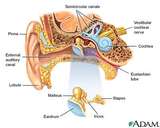 Otitis
Externa is an infection in the outer ear canal.
Another name for this infection is "swimmer's ear"
as this infection can be associated with exposure to
water. The symptoms include redness and swelling of
the skin in the ear canal, significant pain of the
ear canal and drainage. Treatment for this infection
includes antibiotic or antifungal eardrops and
possibly oral (by mouth) antibiotics. Preventive
treatments can include rinsing the ears with water
and white vinegar. Ready-made eardrops for this
purpose are also sold at various pharmacies,
although these may contain alcohol that can cause
further irritation. Otitis
Externa is an infection in the outer ear canal.
Another name for this infection is "swimmer's ear"
as this infection can be associated with exposure to
water. The symptoms include redness and swelling of
the skin in the ear canal, significant pain of the
ear canal and drainage. Treatment for this infection
includes antibiotic or antifungal eardrops and
possibly oral (by mouth) antibiotics. Preventive
treatments can include rinsing the ears with water
and white vinegar. Ready-made eardrops for this
purpose are also sold at various pharmacies,
although these may contain alcohol that can cause
further irritation.
Otitis Media is also known as a middle ear infection
(an infection in the space behind the ear drum). For
children, otitis media is one of the most common
infections. More than 90% of all children will have
at least one infection by age 2. Forms include
recurrent acute infections and long-lasting chronic
infections, both of which are treatable.
Ear infections can be caused by bacteria or viruses.
Risk factors include day care (and smoking in the
home. Allergies may contribute to ear disease but
are not usually the direct cause of infections.
Ear infections, for some children, are very painful.
Commonly associated symptoms include pulling on the
ears, increased irritability or behavioral changes,
awakening at night, fever, decreased appetite, not
wanting to lie flat, or a loss of balance. You
should contact your physician if your child is
experiencing ear pain or if you suspect an
infection. Some children have little or no
discomfort, and ear infections in these children may
be picked up only upon a physician visit or as part
of an examination for another complaint. |
| Article Source: |
| http://www.entandallergy.com/services/peds.php |
|
Back To Top |
| |
|
Ear, Nose and Throat (ENT)
Surgery |
Ears, nose, throat (ENT) surgery comprises many
different types of surgical procedures and is one of
the oldest surgical specialties. It is also one of
the most elaborate fields of surgery, using advanced
technology and encompassing a broad range of
procedures including major reconstructive surgery.
Typically, ear surgery is used to correct defects
causing hearing loss or impairment. Such procedures
include tympanoplasty (reconstruction of the ear
drum), stapedectomy (removal of all or part of a
bone in the middle ear), and cochlear implants
(implantation of a device to stimulate nerve ends
within the ear to enable hearing). Myringotomy
(insertion of ear tubes to drain fluid in persons
with chronic ear infections) is another common
procedure.
Care of the nasal cavity and sinuses is one of the
primary skills of the ENT specialist. Common
Surgical procedures of the nose can include sinus
surgery, correction of a deviated septum (septoplasty)
and relief of chronic nasal congestion. Advanced
endoscopic surgery for sinus and nasal disorders can
eliminate the need for external incisions and major
surgery.
The ENT specialist is also called upon to manage
diseases of the larynx (voice box) and the esophagus
including disorders of the voice, respiration
(breathing) and problems swallowing. Surgery of the
throat includes removal of tonsils (tonsillectomy)
or adenoids (adenoidectomy). Tonsils and adenoids
are lymph tissue that help in the body’s defenses to
fight infection. The tonsils and adenoids can get
chronically infected, in which case surgical removal
is usually required. Chronic inflammation of the
adenoids can also cause repeated middle ear
infections that can ultimately impair hearing.
Recovery for ENT surgery depends on the procedure
and health of the patient. Because of the high
possibilty of infections, cleansing and dressing
changes of the wound as well as postoperative
follow-up with the ENT surgeon is essential.
Patients may need to stay in the hospital for eight
to 10 hours for procedures such as tonsillectomy
depending on the anesthesia, or they may be admitted
for a few days for more complicated procedures.
|
| Article Source: |
| http://www.indiahospitaltour.com/ear-nose-throat-ent-surgery-india.html |
|
Back To Top |
| |
|
Neuromonics Tinnitus
Treatment Study Published in ENT Journal |
Editor: A study published in 'ENT Journal'
documents the effectiveness of the Neuromonics
Tinnitus Treatment program. Here's the story from
the folks at Neuromonics.
June 2008
Neuromonics Inc has announced the publication of the
first clinical study evaluating the Neuromonics
Tinnitus Treatment's effectiveness compared to
relevant control groups. Published in the June 15
issue of ENT Journal, the study demonstrates that
patients receiving Neuromonics Tinnitus Treatment
reported significantly greater improvements in
tinnitus disturbance than those receiving an
equivalent rehabilitation and counseling program
with broadband noise acoustic stimulus or no
acoustic stimulation. Broadband noise, a traditional
approach designed to "mask" the tinnitus, did not
significantly improve tinnitus disturbance compared
to the counseling-only group. Only the Neuromonics
Tinnitus Treatment demonstrated significant
improvements over time, according to the report.
The study's 50 patients had clinically significant
tinnitus, a condition commonly characterized by
ringing in the ears. They were randomly assigned to
treatment groups. The primary measure for clinical
benefit was the Tinnitus Reaction Questionnaire (TRQ),
a self-report measure of tinnitus-related
disturbance and impact on quality of life. Six-month
mean TRQ improvements for patients receiving
Neuromonics was 66%, as compared to broadband
stimulation or no acoustic stimulation, which were
22% and 15%, respectively.
"The study further validates the Neuromonics
Tinnitus Treatment's effectiveness for this
widespread and devastating condition," says Peter
Hanley, PhD, executive vice president of Neuromonics
and study co-author. "Because Neuromonics is
assessed relative to appropriate controls, which
differ only by the nature of the acoustic stimulus,
this data confirms the efficacy of the Neuromonics
treatment's customized neural stimulus."
The Neuromonics Tinnitus Treatment delivers a
prescribed acoustic neural stimulus, customized for
each patient's individual audiological profile, and
delivered within specially processed music. The
stimulus is designed to provide relief and
relaxation in the initial phase of treatment, and
then progressively over a period of several months,
to facilitate desensitization to the tinnitus. In
this way, the therapy is said to help the brain
filter out the tinnitus sound, so that it no longer
intrudes on the patient's conscious attention, and
no longer has a disturbing impact on quality of
life. By targeting the condition's underlying
neurological basis, the treatment path may offer
enhanced effectiveness for patients compared to
alternatives such as tinnitus maskers or hearing
aids.
Key results reported by the study include:
* Significant clinical success, defined as the
percent of patients reporting a 40% or greater
improvement in TRQ score, was 86% for the
Neuromonics group, compared to 47% and 23% for
broadband noise and no sound stimulation groups,
respectively.
* Based on patient self-reported ratings, the
Neuromonics group had significantly greater and more
consistent improvements in sleep and relaxation
compared to the other two groups. A total of 86% of
the Neuromonics group reported sizeable relaxation
benefits.
* Minimum masking levels, a measure of tinnitus
perception, was significantly reduced in the
Neuromonics group, with mean improvement of 9.9 dB
at 6 months. Changes were not significant for the
two control groups.
* Ratings for tolerance of loud sound were
significantly improved within the Neuromonics group.
Changes were not significant for the two control
groups. Note: Tinnitus is often associated with the
inability to tolerate loud sounds, or hyperacusis.
About the Neuromonics Tinnitus Treatment.
Neuromonics' non-invasive, FDA-cleared device is
customized to the patient's unique hearing and
tinnitus profile. It delivers a customized neural
stimulus that promotes neural plastic changes,
allowing the brain to filter out the disturbing
tinnitus sound. This stimulus is delivered within
spectrally modified, customized music, which engages
the brain's emotional response center, the limbic
system, and thereby reduces tinnitus-related
disturbance. Research published in the April 2007
issue of Ear & Hearing and subsequently reported in
the September 13 edition of The Insider demonstrates
the treatment yields clinically significant
reduction in tinnitus disturbance in more than 90%
of suitable patients. Neuromonics contends that its
treatment is the most comprehensive, long-term
therapy that targets the neurological processes of
tinnitus, specifically its audiological,
attention-based, and emotional aspects.
Clinically administered and monitored, the treatment
is reported to yield significant long-term reduction
of tinnitus disturbance. The therapy is delivered
via a compact, lightweight and uniquely designed
medical device. Treatment typically occurs over an
approximately 6-month period, with daily use
recommended for 2 or more hours per day, especially
when the tinnitus is most disturbing. The treatment
can take place during regular activities such as
reading, relaxing, or computer work. |
| Article Source: |
| http://www.hearinglossweb.com/Medical/Tinnitus/neuro2.htm |
|
Back To Top |
|
|
|
|
|
|
|
| |
|